

A dangerous explosive must not become a lasting environmental hazard.
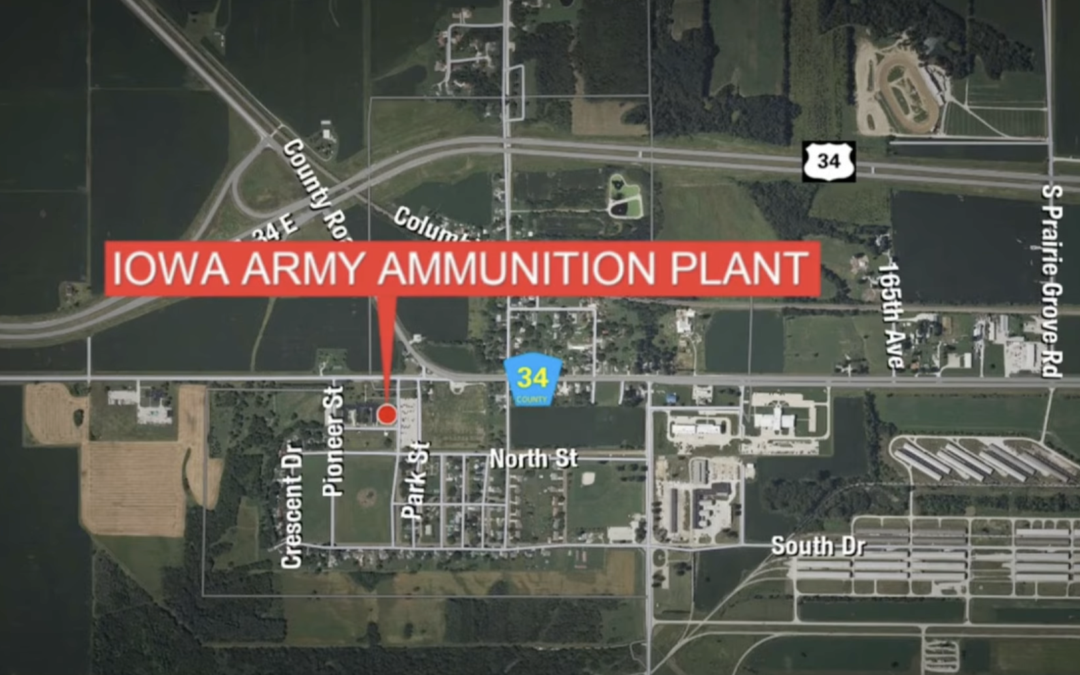
Environmental Health Trust (EHT) calls on the U.S. Army and Environmental Protection Agency to postpone the planned November 20 detonation of nearly 10,000 pounds of deteriorating lead azide at the Iowa Army Ammunition Plant until independent explosives-safety and environmental-health experts have reviewed the risks and determined whether safer containment or treatment alternatives are feasible.
The Army acknowledges that the explosions will send lead-containing dust into the atmosphere. What goes up must come down—on soil, crops, homes, and potentially into waterways.
Lead does not become harmless simply because it has been blown into smaller pieces.
There is no known safe level of lead exposure for children. Even relatively low exposures can damage the developing brain and nervous system. Lead persists in the environment, and its effects can continue long after the noise of an explosion has faded.
The Army faces a genuine emergency: aging lead azide is dangerously unstable, and moving it may pose unacceptable risks. Those dangers must not be minimized. But neither should the consequences of deliberately dispersing lead into the surrounding environment.
We call on the Army and EPA to take five immediate steps:
- Delay the detonation unless independent explosives specialists determine that postponement would itself create an unacceptable immediate danger.
- Release the complete environmental assessment, atmospheric dispersion predictions, estimated lead releases, and supporting data for public review.
- Obtain independent evaluation of feasible containment and treatment alternatives that do not require transporting the unstable material.
- Establish independently verified monitoring of air, soil, surface water, drinking water, and agricultural areas, with publicly accessible baseline and follow-up results.
- Guarantee prompt remediation and long-term accountability for any contamination resulting from the operation.
A federal emergency permit is not a substitute for transparent scientific review!
The question is not whether unstable explosives must be safely eliminated. Of course they must. The question is whether the proposed solution replaces one serious danger with another—and whether the communities potentially exposed to lead have been given sufficient information and protection.
The explosion may last seconds. The lead it leaves behind could remain for generations.
This dangerous, ill-conceived plan will blow up a known nerve toxin and distribute it into the air, water, and cornfields of Iowa, as well as into the tropopause where the winds and weather can carry it long distances.
Environmental Health Trust urges the Army, EPA, Iowa public health authorities, and elected officials to ensure that protecting the public from an immediate explosive danger does not come at the expense of their long-term health.
– Devra Davis, MPH, PhD
Founder, Environmental Health Trust
Dr. Devra Davis is the former executive director of the Board on Environmental Studies and Toxicology of the National Academies of Science, Medicine, and Engineering, and the Department of Defense Committee on Toxicology — the group that advised DOD on management and decontamination of chemical weapons.
To read more about this incomprehensible situation, read the interview with Dr. Davis in today’s Des Moines Register:
Toxicologist: Plan to detonate lead azide in Iowa a ‘dumpster fire’
What can you do to help?
Call the following government officials to demand an immediate halt to the lead azide detonation, and to call for an independent review by environmental experts:
Governor Kim Reynolds: 515-281-5211
Senator Chuck Grassley: 202-224-3744
Senator Joni Ernst: 202-224-3254
Iowa U.S. House Representatives 1st District Mariannette Miller-Meeks: 202-225-6576
The U.S. Environmental Protection Agency (EPA), which issued the emergency permit authorizing the in-place detonation:
Patricia Murrow (EPA Project Manager). 913-551-7627
If you can help EHT in its efforts to protect public health and the environment, please make a donation below.